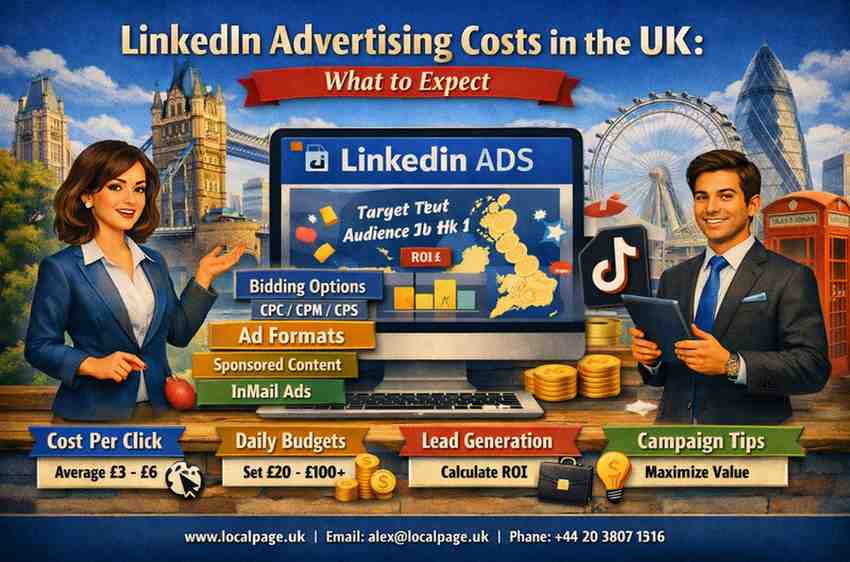
LinkedIn advertising costs in the UK: What to expect
LinkedIn is the most expensive major advertising platform available to UK businesses, yet for B2B companies targeting decision-makers, it frequently delivers the highest return on investment of any channel. The challenge is understanding exactly what to budget, how costs are calculated, and which levers you can pull to improve efficiency without sacrificing the quality of your audience. For anyone investing in business advertising UK, grasping LinkedIn’s cost structure is not optional — it is the difference between profitable campaigns and wasted spend.
Why LinkedIn Advertising Costs Matter for UK Businesses
Every pound spent on LinkedIn must work harder than a pound spent elsewhere because that pound costs more to begin with. A typical UK business might pay two to five times more per click on LinkedIn compared to Facebook or Google for the same broad demographic. But that comparison is misleading. LinkedIn does not sell clicks from general audiences — it sells clicks from precisely defined professionals: specific job titles, seniority levels, industries, company sizes, and skill sets. The cost is higher because the audience is more valuable.
Consider a management consultancy in London targeting Finance Directors at companies with 50 to 200 employees in the South East. On Facebook, reaching “people interested in finance” costs less per click, but the vast majority of those clicks come from students, junior analysts, or retirees — none of whom are decision-makers. On LinkedIn, every click can be restricted to people who actually hold the title “Finance Director” at companies matching the size criteria. The cost per click is higher, but the cost per qualified lead is often dramatically lower.
This distinction matters because UK businesses routinely misallocate budgets by comparing surface-level costs across platforms without accounting for audience quality. A consultancy spending £5 per click on Facebook and converting at 0.5% is paying £1,000 per lead. The same consultancy spending £25 per click on LinkedIn but converting at 5% is paying £500 per lead. The higher-cost platform delivers the lower-cost lead. Understanding this dynamic is foundational to using online business advertising UK effectively.
Never evaluate LinkedIn costs in isolation. Always calculate your cost per qualified lead or cost per acquired customer, then compare that figure across channels. Surface-level metrics like CPM and CPC are distracting without conversion data to give them meaning.
Understanding LinkedIn’s Cost Structure in the UK Market
LinkedIn uses an auction system where advertisers bid for impressions and clicks against other businesses targeting similar audiences. Costs fluctuate based on competition, seasonality, audience specificity, and creative quality. Understanding the mechanics of this system allows you to predict and control your expenditure rather than reacting to it after the money is spent.
Bidding Models Explained
LinkedIn offers three bidding options: cost per click (CPC), cost per impression (CPM), and cost per send (for Message Ads). For most UK B2B campaigns, CPC is the safest starting point because you only pay when someone actively engages. CPM suits brand awareness campaigns where visibility matters more than direct response. Cost per send applies exclusively to Sponsored InMail and is the most expensive format per interaction but can deliver high conversion rates when the messaging is genuinely valuable to the recipient.
What Drives Costs Up or Down
Audience specificity is the single largest cost driver. Targeting “all professionals in London” produces a low cost per click because the audience is enormous and competition is diffuse. Targeting “Chief Technology Officers at UK software companies with 100 to 500 employees” produces a high cost per click because the audience is small and multiple advertisers are competing for the same limited pool. This is not a flaw in the system — it is the price of precision.
Seasonality also affects costs. January and September see elevated CPMs as marketing budgets refresh and agencies deploy annual campaigns. July and August typically offer lower costs as decision-makers take holidays and campaign activity dips. Planning your major LinkedIn campaigns around these seasonal patterns can reduce costs by 15 to 25 percent without changing your targeting or creative.
LinkedIn’s relevance score — similar to Facebook’s quality ranking — rewards adverts that generate engagement. If your advert receives high click-through rates, LinkedIn reduces your effective cost per click over time. Poor-performing adverts get more expensive, not less. Creative quality is a direct cost lever.
Traditional vs Modern B2B Advertising in the UK
The landscape for reaching UK business decision-makers has transformed over the past decade. Understanding where LinkedIn fits within this evolution helps justify its costs and position it correctly within your overall strategy for business advertising UK.
The Traditional B2B Playbook
Before digital channels matured, UK B2B companies relied on trade exhibitions, industry publications, direct mail, telemarketing, and referral networks. These channels had genuine strengths — trade shows generated face-to-face relationships, trade press carried editorial credibility, and referrals came with built-in trust. But they also had severe limitations. Trade show attendance cost thousands per event for a few days of exposure. Trade publications reached audiences on declining schedules. Direct mail response rates hovered below 2%. Telemarketing faced increasing resistance from gatekeepers and call-screening technology.
The Modern Digital Advantage
LinkedIn has not replaced all of these channels, but it has displaced many of them for initial prospecting and awareness. A software company in Bristol that previously spent £8,000 annually on trade show stands can now run a year-round LinkedIn campaign for the same budget, reaching thousands of precisely targeted decision-makers continuously rather than for three days in a conference hall. The trade show still has value for closing relationships, but LinkedIn handles the discovery and nurture stages more efficiently and with full performance tracking.
The critical shift is from episodic to continuous engagement. Traditional B2B advertising operated in campaigns — bursts of activity followed by silence. Modern digital advertising, including LinkedIn, enables always-on presence where prospects encounter your brand repeatedly over weeks and months. This continuous exposure mirrors how B2B buying actually works: long consideration cycles involving multiple stakeholders, not impulse decisions.
Abandoning trade shows and traditional channels entirely in favour of LinkedIn. The most successful UK B2B companies use LinkedIn for top-of-funnel discovery and nurture, then convert through direct engagement — whether at events, via phone, or in face-to-face meetings. LinkedIn is a pipeline builder, not a complete replacement for relationship-driven sales.
LinkedIn Advertising Cost Breakdown for UK Campaigns
Accurate budgeting requires realistic benchmarks. The following figures represent 2026 UK averages across multiple industries and campaign types. These are not guarantees — actual costs vary significantly based on your specific targeting, creative, and industry — but they provide a reliable planning framework for your business advertising packages UK when LinkedIn is included as a channel.
Cost Per Click (CPC) by Industry
- Software and technology: £8–£18 per click
- Financial and professional services: £10–£22 per click
- Management consulting: £12–£25 per click
- Recruitment and HR: £6–£14 per click
- Manufacturing and engineering: £7–£15 per click
- Education and training: £5–£12 per click
- Healthcare and life sciences: £9–£20 per click
Cost Per Impression (CPM) Benchmarks
Across UK B2B campaigns, CPMs typically range from £25 to £60 for standard Sponsored Content, with premium formats like Conversation Ads and Thought Leader Ads commanding £40 to £80 CPMs. Audience specificity remains the primary variable: broadly targeted campaigns sit at the lower end, whilst tightly defined senior-level audiences push toward the upper range.
Cost Per Lead Estimates
Cost per lead on LinkedIn varies even more than cost per click because conversion rates differ enormously by industry, offer quality, and landing page effectiveness. As a general guide, UK B2B companies can expect to pay £30 to £80 per lead for content downloads, £50 to £150 per lead for webinar registrations, and £100 to £300 per lead for demo requests or consultation bookings. The wide ranges reflect the reality that LinkedIn lead costs are highly sensitive to offer quality — a generic whitepaper will always cost more per lead than a compelling, specific piece of research.
Minimum Budget Recommendations
LinkedIn’s minimum daily budget is £5 per campaign, but this is far too low for meaningful B2B results. A realistic test budget starts at £30 to £50 per day per campaign, which translates to £900 to £1,500 per month. For established campaigns running at scale, monthly budgets of £3,000 to £10,000 are common among UK B2B companies serious about LinkedIn as a lead generation channel.
affordable business advertising UK — explore fixed-price listing packages that complement LinkedIn campaigns by providing continuous directory visibility at a fraction of the cost per impression.
How to Promote My Business UK Through LinkedIn Lead Generation
Generating leads on LinkedIn requires more than setting up a campaign and choosing a bid. The platform rewards advertisers who understand its specific mechanics and who create campaigns that feel native to the professional environment. Here is a practical breakdown of the most effective lead generation approaches available to UK businesses.
Lead Gen Forms: The Highest-Conversion Format
LinkedIn’s native lead generation forms auto-populate with the user’s profile data — name, email, job title, company. This removes the friction of filling in forms manually and produces conversion rates three to four times higher than driving traffic to external landing pages. A financial services firm in Edinburgh offering a pension review guide might achieve a 5 to 8% conversion rate on LinkedIn lead forms compared to 1.5 to 2% on a dedicated landing page. The trade-off is less control over the post-submission experience, but for top-of-funnel lead capture, lead gen forms are difficult to beat.
Document and Carousel Ads for B2B Storytelling
UK professionals engage strongly with content that demonstrates expertise rather than simply declaring it. Document ads — PDF carousels that users swipe through within the feed — allow you to present case studies, frameworks, research findings, or how-to guides in a format that feels native to LinkedIn’s professional context. A logistics company in the Midlands publishing a five-slide carousel on “Reducing Supply Chain Costs in UK Manufacturing” will generate more meaningful engagement than a static image advert making the same claim.
Sponsored InMail for High-Value Outreach
Sponsored InMail delivers your message directly to a prospect’s LinkedIn inbox. The format is expensive — typically £30 to £60 per send — but for high-value B2B offers such as enterprise software demonstrations, board advisory invitations, or exclusive event access, the conversion rates can justify the cost. The critical requirement is that the message must offer genuine value. Generic sales pitches sent via InMail generate complaints and damage your brand; personalised, insight-driven messages generate responses.
Start with a single lead gen form campaign offering your most valuable content asset — a piece of original research, an industry benchmark report, or a practical toolkit. Set your audience slightly broader than your ideal customer profile to reduce costs, then qualify leads during follow-up. This approach generates pipeline quickly whilst you refine targeting for subsequent campaigns.
GEO Targeting: Reaching UK Cities and Regions on LinkedIn
Geographic targeting on LinkedIn offers granularity that most UK businesses underutilise. The platform allows targeting by country, region, postcode, and radius from a specific location. For businesses whose service area is geographically defined — consultancy firms, legal practices, construction companies, event venues — this capability is essential for cost efficiency.
Targeting London: Precision Within Scale
London presents the largest LinkedIn audience in the UK but also the highest competition and costs. A management consultancy targeting “all professionals in London” would face CPMs of £50 to £70 and an audience so broad that conversion rates would suffer. The smarter approach is to layer geographic targeting with postcode specificity. Targeting EC1, EC2, EC3, and EC4 — the City of London and its immediate surroundings — reaches financial services decision-makers at a fraction of the cost of targeting all of London. A legal firm might focus on W1 and WC2 for Mayfair and Covent Garden, where many corporate law clients are concentrated.
Regional Powerhouses: Manchester, Birmingham, Leeds, Glasgow
These cities represent the largest professional LinkedIn audiences outside London, and costs per click are typically 20 to 35% lower than the capital. A technology company based in Manchester can target the city centre postcodes (M1, M2, M3, M4) plus Salford Quays (M50) and reach a dense professional audience at costs that would be impossible to achieve in London for equivalent seniority levels. The same principle applies to Birmingham (B1–B5), Leeds (LS1–LS3), and Glasgow (G1–G2).
Nationwide Targeting Without the Waste
Some UK businesses genuinely serve the entire country — SaaS companies, online training providers, national recruitment firms. For these businesses, nationwide targeting is appropriate, but it should still be strategic. Rather than selecting “United Kingdom” as a single location, consider creating separate campaigns for different regions with creative adapted to local contexts. A recruitment firm might run one campaign for the South East, another for the North West, and a third for Scotland, each referencing regional hiring trends and client locations. This regional personalisation typically improves click-through rates by 15 to 25% compared to generic national creative.
LinkedIn is expanding its radius targeting capabilities, allowing advertisers to combine postcode-level precision with radius overlap. This means you can target a 15-mile radius around your office in Bristol whilst simultaneously excluding specific postcode areas where you do not operate, creating highly efficient geographic shapes that match your actual service area.
Step-by-Step Strategy for LinkedIn Advertising in the UK
Implementing a structured approach prevents the budget bleed that occurs when businesses launch LinkedIn campaigns without a clear framework. Follow this sequence to build campaigns that deliver predictable results for business advertising UK on LinkedIn.
Step One: Define Your Ideal Customer Profile
Before touching LinkedIn Campaign Manager, document the exact attributes of your best customers. Job titles, seniority levels, industries, company sizes, and geographic locations should all be specified. Use your existing customer data rather than assumptions. If your five best clients are all Operations Directors at manufacturing companies with 100 to 300 employees in the Midlands, that is your starting audience — not “senior professionals in UK manufacturing.”
Step Two: Map the Funnel Stage
Determine whether your campaign targets awareness, consideration, or decision-stage prospects. Each stage requires different creative, different offers, and different success metrics. Awareness campaigns use educational content and measure impressions and engagement. Consideration campaigns offer downloadable assets and measure leads. Decision-stage campaigns promote demos, consultations, or trials and measure conversions and pipeline value.
Step Three: Build Three Audience Variations
Create three audience tiers: a narrow audience matching your ideal customer profile exactly, a slightly broader audience relaxing one criterion, and a wider audience relaxing two criteria. Run identical creative across all three and compare cost per lead after 14 days. The data will reveal which audience balance delivers the best efficiency, informing all future campaigns.
Step Four: Create Platform-Native Creative
Design advert creative that looks like professional LinkedIn content, not traditional advertising. Use professional imagery — real workplace photos, not stock images of handshakes. Write headlines that state a clear benefit or insight, not a tagline. Keep body copy concise and focused on the prospect’s problem, not your solution. Include a single, unambiguous call to action.
Step Five: Launch, Monitor, Optimise
Launch with CPC bidding and a daily budget you can sustain for 30 days. Monitor every three days for the first two weeks but resist making changes during the first seven. After two weeks, review performance by audience, creative, and placement. Pause underperforming elements, reallocate budget to winners, and continue iterating in two-week cycles.
Step Six: Implement Lead Nurturing
Leads from LinkedIn rarely convert immediately. Build an email nurture sequence that delivers additional value over four to six weeks before making a sales approach. Simultaneously, use LinkedIn’s retargeting capabilities to serve follow-up adverts to people who downloaded your content but did not convert further. This multi-touch approach typically doubles conversion rates compared to a single follow-up call.
Common Mistakes That Inflate LinkedIn Ad Costs
Most UK businesses overspend on LinkedIn not because the platform is inherently expensive, but because they make avoidable errors that drive costs upward. Recognising and eliminating these mistakes is one of the fastest ways to improve the efficiency of your small business advertising UK on LinkedIn.
Mistake One: Over-Specific Targeting
Targeting a single job title at a single company size in a single postcode produces an audience so small that LinkedIn cannot efficiently deliver it. The algorithm struggles to find enough matching users, costs per click spike, and delivery becomes erratic. If your ideal customer is “Marketing Director at UK tech companies with 50 to 200 employees,” broaden to include “Head of Marketing,” “VP Marketing,” and “CMO” and expand the company size to 20 to 500 employees. You can qualify leads more precisely during follow-up.
Mistake Two: Ignoring Audience Overlap
Running multiple campaigns that target overlapping audiences forces LinkedIn to auction your own adverts against each other. If Campaign A targets “CTOs in London” and Campaign B targets “Technology leaders in the South East,” users who match both criteria see both adverts, and you effectively bid against yourself. Use LinkedIn’s Audience Overlap tool to identify and resolve conflicts before they inflate costs.
Mistake Three: Weak Creative That Suppresses Relevance Scores
LinkedIn’s algorithm rewards high-engagement adverts with lower effective costs. If your creative generates low click-through rates — below 0.3% is typically problematic — LinkedIn charges you more per click because it perceives your advert as low quality. Investing in stronger headlines, professional imagery, and compelling offers is not a creative luxury — it is a direct cost-reduction strategy.
Mistake Four: Sending Traffic to Poor Landing Pages
Driving LinkedIn traffic to a generic homepage, a page that does not match the advert’s offer, or a page with slow loading speed wastes every pound spent on the click. Your landing page must align perfectly with your advert: the same offer, the same messaging, and a clear next step. A 3-second delay in page load time can reduce conversions by 30%, making your effective cost per lead significantly higher even if your cost per click remains unchanged.
Setting it and forgetting it. LinkedIn campaigns require active management. The businesses achieving the best results review performance weekly, adjust targeting and creative fortnightly, and fully rebuild campaigns quarterly. Treat LinkedIn as a living system, not a set-and-forget tool.
Voice Search Optimisation for LinkedIn Ad Landing Pages
The connection between LinkedIn advertising and voice search may not be immediately obvious, but it exists and matters for UK B2B companies pursuing integrated digital business advertising UK strategies. When a decision-maker encounters your brand through a LinkedIn advert and later uses voice search to find your business, the quality of your local search presence determines whether they find you or a competitor.
The Voice Search Discovery Pathway
Imagine a procurement manager in Leeds who clicks your LinkedIn advert, downloads a whitepaper, and then days later asks their phone “find me a managed IT services company near Leeds.” If your Google Business Profile is optimised, your directory listings are consistent, and your website contains location-specific service pages, you appear in those voice search results. If your digital footprint is thin, that prospect finds a competitor instead. The LinkedIn advert generated the initial awareness, but voice search captured the intent.
Optimising for Voice Queries
Voice queries are conversational and location-specific. “Find me” and “near me” constructions dominate. To capture these, your website and directory listings should include natural-language phrases that match how people speak, not just how they type. A page titled “IT Support Services in Leeds” serves typed search well, but a page that also includes phrases like “managed IT support for businesses in Leeds and West Yorkshire” captures voice queries more effectively. Ensure your Google Business Profile uses complete, natural business descriptions rather than keyword-stuffed fragments.
Add a frequently asked questions section to your service pages using natural, conversational language. Questions like “How quickly can you respond to IT issues in Leeds?” directly mirror voice search queries and improve your chances of appearing in voice results.
AI SEO and Semantic SEO for LinkedIn Campaign Success
Artificial intelligence is transforming how LinkedIn serves adverts and how search engines evaluate your landing pages. The businesses that understand these changes gain a dual advantage: more efficient LinkedIn delivery and stronger organic visibility for the traffic that LinkedIn generates.
How LinkedIn’s AI Evaluates Your Adverts
LinkedIn’s algorithm in 2026 goes well beyond keyword matching. It analyses the semantic content of your adverts — the topics you discuss, the entities you reference, and the professional context you establish — to determine which users are most likely to engage. An advert for a cybersecurity consultancy that mentions specific frameworks like “ISO 27001,” “NCSC Cyber Essentials,” and “GDPR compliance” signals to the algorithm that this content is relevant to cybersecurity professionals, even if those terms are not in the targeting criteria. This semantic matching improves delivery precision and can reduce costs by placing your advert in front of more relevant users.
Applying Semantic Principles to Landing Pages
When LinkedIn traffic arrives on your landing page, Google’s AI evaluates that page’s semantic quality to determine its ranking in search results. Pages that thoroughly cover a topic — including related concepts, entities, and natural variations — rank higher than pages that repeat a single keyword. A landing page for a financial consultancy that discusses “cash flow forecasting,” “working capital management,” “financial modelling,” and “strategic financial planning” demonstrates topical depth that Google rewards, making the page more likely to appear in organic search for any of those terms.
Practical Steps for UK Advertisers
- Include specific industry terms, frameworks, and certifications in your LinkedIn advert copy to improve semantic matching
- Build landing pages that cover topics comprehensively rather than targeting single keywords
- Use structured data markup on landing pages to help search engines understand your content
- Create clusters of related content on your website that link back to your key landing pages
- Ensure your LinkedIn profile, website, and directory listings all describe your services using consistent terminology
LinkedIn’s AI in 2026 analyses the relationship between your advert content and the content of the page it links to. If your advert discusses “GDPR compliance consulting” but your landing page is a generic consultancy homepage with no mention of GDPR, the algorithm reduces delivery because the page does not match the advert promise. Alignment between advert and landing page content is now a ranking signal within LinkedIn itself.
Conversion Strategy: Turning LinkedIn Impressions into UK Clients
Impressions and clicks are intermediate metrics. Revenue is the only metric that ultimately matters. Converting LinkedIn attention into paying clients requires a conversion strategy that accounts for the realities of B2B buying behaviour in the UK market.
The B2B Conversion Reality
UK B2B purchase decisions involve an average of 6.8 stakeholders and take between three and six months from initial awareness to contract signature. A LinkedIn campaign that generates a lead today will not produce revenue tomorrow. Businesses that expect immediate conversion from LinkedIn are measuring the wrong thing. The correct framework treats LinkedIn as a pipeline builder: each lead enters a nurture process that gradually moves them toward a purchasing decision.
Speed of Response Matters Enormously
Research consistently shows that B2B leads contacted within five minutes are 21 times more likely to convert than those contacted after 30 minutes. Despite this, many UK businesses take hours or days to respond to LinkedIn leads. Implementing an immediate response system — whether automated email acknowledgement followed by a personal call within the hour, or an automated scheduling link that lets leads book a call directly — is the single highest-impact conversion improvement most businesses can make.
Building Trust Through Multi-Channel Reinforcement
When a prospect clicks your LinkedIn advert and visits your website, they will also search for your brand. What they find in those search results directly affects their likelihood of converting. A strong Google Business Profile, positive reviews on relevant platforms, professional directory listings, and consistent brand presence across the web all build the trust that converts a lead into a client. This is where business visibility services UK become a direct revenue driver, not a nice-to-have.
Ensure your brand is credible when LinkedIn prospects search for you
Local Page UK provides the directory presence and visibility infrastructure that turns LinkedIn-generated interest into converted clients. When prospects verify your business, they should find a robust, professional digital footprint.
Mini Case Study: UK Consultancy Reduces Cost Per Lead by 62%
The Business
A change management consultancy based in Reading, Berkshire, serving mid-market UK companies undergoing organisational transformation. Annual revenue approximately £1.2 million, with growth stalled for 18 months due to an over-reliance on referrals and an inconsistent approach to new business development.
The Challenge
The consultancy had experimented with LinkedIn advertising over six months, spending approximately £4,800 with disappointing results. Their campaigns targeted “CEOs and MDs at UK mid-market companies” — an audience of over 40,000 — with generic brand awareness creative. Average cost per click was £19, average click-through rate was 0.22%, and they generated just 11 leads, none of which converted to clients. Effective cost per acquired customer was incalculable because there were zero acquisitions.
The Strategy
We rebuilt the campaign from the ground up. The audience was narrowed to CEOs and MDs at UK companies with 50 to 300 employees in manufacturing, logistics, and professional services — reducing the audience to approximately 8,500. Creative was changed from brand awareness messages to a specific offer: a downloadable “Organisational Readiness Assessment” framed as a practical tool, not a sales piece. Lead gen forms replaced landing page traffic. CPC bidding was maintained but with a higher daily budget concentrated into fewer, more targeted campaigns.
The Results (90 Days)
- Total spend: £3,600 (£1,200 per month)
- Average cost per click: £14.20 (down 25%)
- Average click-through rate: 0.58% (up 164%)
- Total leads generated: 67 (up 509%)
- Cost per lead: £53.73 (down 62%)
- Leads converted to discovery meetings: 14
- Discovery meetings converted to retained clients: 4
- Revenue from converted clients: £96,000
- Return on ad spend: 26.7:1
Key Takeaway
The improvement did not come from spending more — the monthly budget was actually reduced. It came from tightening the audience, replacing generic creative with a specific offer, and using lead gen forms to eliminate landing page friction. The consultancy’s previous failure was not a LinkedIn problem; it was a strategy and execution problem.
2026 Trends in UK LinkedIn Advertising
The LinkedIn advertising platform evolves rapidly, and businesses that adopt new capabilities early gain temporary competitive advantages. The following trends are shaping how UK advertisers use LinkedIn in 2026 and should inform your planning for business advertising UK.
Thought Leader Ads at Scale
Thought Leader Ads allow businesses to sponsor content published on the personal LinkedIn profiles of their executives and team members. This format is outperforming traditional Sponsored Content because users engage more readily with individual voices than corporate accounts. A consultancy in Bristol might sponsor content from its founding partner’s personal profile rather than the company page, achieving two to three times higher engagement rates. In 2026, this format is becoming a primary channel for B2B thought leadership rather than a supplementary tactic.
AI-Powered Audience Recommendations
LinkedIn’s AI now analyses your existing customer data and website visitors to recommend audience segments you may not have considered. A UK recruitment firm discovered through AI recommendations that their most responsive audience was not HR Directors — their assumed target — but Founders and COOs at companies with 10 to 50 employees. This insight, which contradicted their initial strategy, led to a 40% reduction in cost per lead. The AI identifies patterns in data that human planners routinely miss.
Conversational Ads for Multi-Touch Engagement
Conversation Ads present a series of messages within the LinkedIn messaging interface, allowing prospects to choose their own path through different content options. For complex B2B offerings where a single message cannot convey full value, this format enables progressive engagement: an initial insight, followed by a choice of content paths, followed by a soft call to action. UK advertisers using Conversation Ads report higher quality leads because the self-selection process pre-qualifies prospects before they submit their details.
Enhanced Attribution and Offline Tracking
LinkedIn’s attribution capabilities now extend beyond online conversions to track offline outcomes — phone calls, in-person meetings, and contract signatures — that originate from LinkedIn touchpoints. For UK businesses with long B2B sales cycles, this improved attribution makes it possible to measure the true ROI of LinkedIn advertising rather than relying on last-click digital attribution that dramatically undervalues awareness-stage interactions.
LinkedIn is testing generative AI tools that create multiple creative variations from a single brief, automatically adapting messaging for different seniority levels and industries. Early UK adopters report that AI-generated variations tailored to specific job titles outperform single-creative campaigns by 15 to 25%, though human oversight remains essential for brand accuracy.
Beyond LinkedIn: Multi-Channel Visibility for UK B2B Businesses
LinkedIn excels at reaching decision-makers, but no single channel should carry your entire growth strategy. The most resilient UK B2B businesses build visibility across multiple channels, creating a presence that captures prospects regardless of where they start their buying journey. This multi-channel approach is the foundation of effective UK business advertising solutions for SMEs and mid-market companies.
Directory Listings as Professional Credibility Signals
When a LinkedIn prospect researches your company, they evaluate your credibility based on what they find beyond your website. Professional directory listings with consistent information, positive reviews, and a complete business profile provide third-party validation that your own website cannot offer. A management consultant in London whose LinkedIn advert leads a prospect to search for them will convert far more effectively if that search reveals a well-maintained presence on respected UK business directories alongside their website and LinkedIn profile.
The Complementarity Principle
LinkedIn generates awareness and initial engagement. Google search captures intent. Directory listings provide credibility. Your website converts. Email nurture maintains the relationship. Each channel plays a specific role, and removing any one weakens the entire system. The businesses that complain about LinkedIn’s costs are often those relying on LinkedIn as their only channel. Those that embed LinkedIn within a multi-channel system consistently report higher returns because every channel amplifies the others.
Cost Efficiency Through Channel Diversification
LinkedIn’s higher costs per impression and click become manageable when balanced against lower-cost channels that maintain visibility between LinkedIn campaigns. Fixed-price directory listings, organic social content, and search engine optimisation provide baseline visibility at predictable costs, allowing you to use LinkedIn strategically for high-value prospecting rather than as the sole driver of your digital presence. This blend of premium and affordable channels delivers the most efficient overall cost per acquisition.
sponsored business advertising UK — discover how sponsored listings on Local Page UK provide continuous professional visibility that reinforces your LinkedIn campaigns and builds trust with prospects who research your business.
Advertising Solutions for Small Businesses Without Large LinkedIn Budgets
Not every UK business can justify £1,500 per month on LinkedIn advertising. Many small businesses, sole traders, and early-stage companies need to generate leads cost-effectively whilst they build the revenue to invest in premium channels. The good news is that effective B2B lead generation does not require a large LinkedIn budget — it requires a strategic approach to the channels you can afford.
Organic LinkedIn as a Starting Point
Before spending a single pound on LinkedIn adverts, invest in your personal and company profile. Post consistently — three to five times per week — with content that demonstrates your expertise: industry commentary, practical advice, case study insights, and questions that invite discussion. Engage meaningfully with content from your target audience. Organic LinkedIn reach has declined, but for niche B2B audiences, a well-executed organic presence still generates enquiries without any ad spend. An independent accountant in Oxford posting weekly tax planning insights can build a steady stream of enquiries from local business owners over six to twelve months.
Fixed-Price Alternatives to PPC
For businesses seeking business advertising without Google Ads UK or LinkedIn PPC, directory and listing platforms offer predictable, fixed-cost visibility. Unlike pay-per-click advertising, where costs fluctuate based on competition and you pay for every interaction regardless of quality, fixed-price listings provide guaranteed exposure at a known cost. This predictability is particularly valuable for small businesses that need to control expenditure whilst building their pipeline.
The Progressive Investment Path
- Months one to three: Build organic LinkedIn presence and secure directory listings
- Months three to six: Add a small LinkedIn test campaign (£30–£50 per day) with a single lead gen offer
- Months six to twelve: Scale LinkedIn spend based on proven cost per lead data, expand directory presence
- Month twelve onwards: Operate a full multi-channel system with LinkedIn as the primary prospecting engine
This progressive approach ensures you never invest in paid channels before you have the foundation to convert the traffic they generate. It also means you are building visible credibility from day one through directory listings, so that when your LinkedIn campaigns do drive prospect research, those prospects find a business that looks established and trustworthy.
Final Action Plan for UK Business Growth Through LinkedIn
Everything covered in this guide leads to a practical sequence you can implement regardless of your current experience with LinkedIn advertising. The businesses that achieve the strongest results from LinkedIn are not those with the largest budgets — they are those with the most disciplined execution.
Week One: Audit and Foundation
Review your LinkedIn company page and personal profiles. Ensure they are complete, professional, and consistent with your website and other digital presence. Install the LinkedIn Insight Tag on your website. Review your existing customer data to build your ideal customer profile. Check that your Google Business Profile and directory listings are accurate and up to date.
Week Two: Audience and Offer Development
Define three audience tiers in Campaign Manager. Develop one high-value lead offer — a piece of original content that solves a genuine problem for your target audience. Write three headline variations and two body copy variations. Select professional imagery that reflects your brand and your audience’s working environment.
Week Three: Campaign Launch
Build your campaign using lead gen forms with CPC bidding. Set your daily budget to a level sustainable for 30 days. Launch all three audience tiers simultaneously with identical creative. Document everything: targeting settings, creative versions, bid amounts, and budget allocation.
Week Four: Initial Review
After seven days, review early performance indicators. Do not make changes yet, but note which audience tiers and creative variations are showing the strongest signals. Check that the Insight Tag is firing correctly and that lead data is flowing into your CRM or spreadsheet.
Ongoing: Optimise, Expand, Integrate
At the 14-day mark, make your first optimisation decisions: pause underperformers, reallocate budget to winners, and consider testing a new creative variation. At 30 days, conduct a full review and calculate your true cost per qualified lead. Begin building your email nurture sequence for leads generated. Expand your directory presence to complement LinkedIn. Repeat the cycle with refined targeting and new offers each quarter.
LinkedIn advertising costs in the UK are higher than other platforms, and that will not change. But the value of reaching precisely defined decision-makers — the exact people who sign off on purchases in your target market — also will not change. The businesses that treat LinkedIn as a precision instrument, calibrated carefully and managed actively, consistently achieve returns that justify the premium. Those that approach it as just another social media channel, setting broad targeting and generic creative, consistently waste money. The difference is strategy, execution, and the willingness to invest in doing it properly. For any UK B2B business serious about growth through business advertising UK, LinkedIn deserves a place in your marketing mix — but only if you are prepared to use it with the rigour it demands.
Frequently Asked Questions
How much should a UK business budget for LinkedIn advertising?
A realistic minimum test budget is £900 to £1,500 per month. Established campaigns typically operate at £3,000 to £10,000 per month depending on target audience specificity and geographic scope. Starting below £30 per day per campaign usually produces insufficient data for meaningful optimisation.
Is LinkedIn advertising worth the cost for UK small businesses?
It depends on your target customer. If you sell to other businesses and need to reach specific decision-makers by job title, industry, or company size, LinkedIn is often the most efficient channel despite higher per-click costs. If you sell to consumers, other platforms will almost always deliver better value.
What is a good cost per lead on LinkedIn in the UK?
For content download leads, £30 to £80 is typical. For webinar registrations, £50 to £150. For demo requests or consultation bookings, £100 to £300. These vary by industry, offer quality, and audience specificity. High-value offers to narrow audiences often produce lower costs per lead than generic offers to broad audiences.
Can I target specific UK cities on LinkedIn?
Yes. LinkedIn allows geographic targeting by country, region, specific city, postcode, and radius from a location. For cost efficiency, combine city targeting with professional criteria rather than targeting a city alone, which creates an unnecessarily broad and expensive audience.
Why is my LinkedIn cost per click so high?
The most common causes are over-specific targeting that produces a tiny audience, low click-through rates that suppress your relevance score, and high competition in your industry or region. Broadening your audience slightly, improving your creative, and testing different bid strategies typically reduce costs.
Should I use LinkedIn lead gen forms or drive traffic to my website?
For top-of-funnel lead capture, lead gen forms typically outperform landing pages because they auto-populate user data and remove friction. For mid and bottom-funnel conversions — demos, consultations, trials — driving to a dedicated landing page gives you more control over the experience and allows for richer qualification.
How long does it take for LinkedIn ads to work?
Expect seven to 14 days for the algorithm to optimise delivery. Meaningful lead generation data typically requires 30 days. Building a reliable pipeline from LinkedIn usually takes three to six months of consistent campaign activity combined with proper lead nurturing.
What type of content works best for LinkedIn adverts in the UK?
Professional, insight-driven content that demonstrates expertise performs best. Document carousels presenting case studies or frameworks, short videos featuring real team members discussing industry challenges, and specific research-based lead magnets all outperform generic brand messages or product-focused imagery.
Can I run LinkedIn ads without a large marketing team?
Yes. The platform is designed for self-service use. A single person can manage effective LinkedIn campaigns with proper training and a structured approach. The key requirements are understanding your ideal customer profile, creating platform-native creative, and committing to regular review and optimisation.
Where can I find cost-effective advertising alternatives to LinkedIn?
Directory platforms like Local Page UK provide fixed-price visibility that complements LinkedIn by building credibility and search presence at predictable costs. Combining LinkedIn for high-value prospecting with directory listings for continuous professional visibility creates a balanced, cost-efficient multi-channel approach.
Make Every LinkedIn Pound Work Harder
LinkedIn generates the leads. Your digital footprint converts them. If your prospects search for your brand after clicking an advert and find nothing credible, that lead is lost. Build the trust infrastructure that turns LinkedIn attention into revenue.
 LocalPage UK Video Marketing & Media Hub
Leave a comment