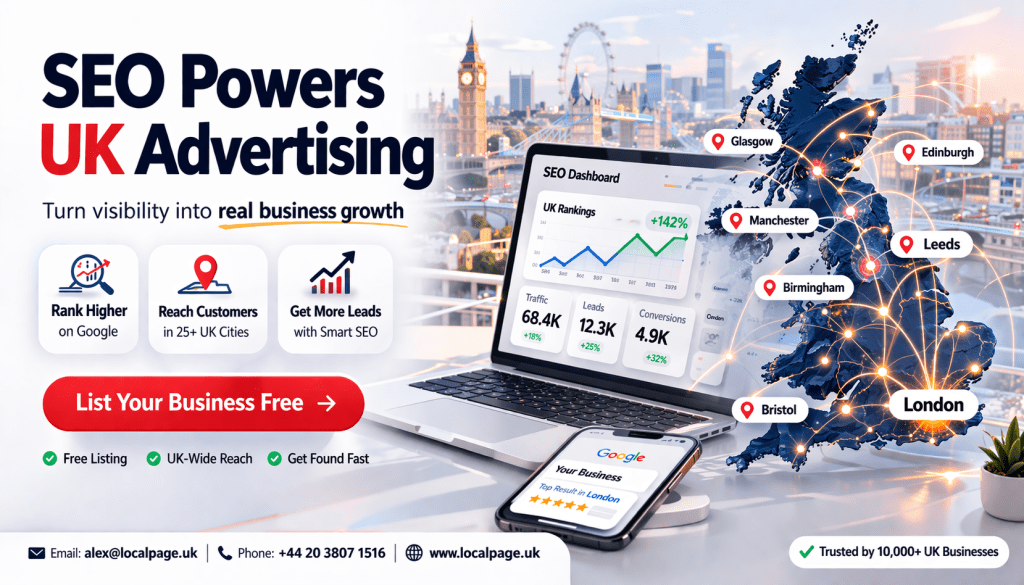
The Role of SEO in UK Advertising Campaigns: The Complete Guide
How advertising solutions for small businesses UK can harness search engine optimisation to cut ad costs, drive sustainable traffic, and build long-term brand authority.
Most UK business owners have experienced the same frustration. You launch a paid advertising campaign. The leads come in. You feel optimistic. Then the moment you pause the spend, the phone stops ringing. The website traffic drops to near zero. You realise, with a sinking feeling, that you have been renting attention — not owning it.
This is the fundamental problem with advertising that ignores SEO. Search engine optimisation is not a standalone tactic. It is the architectural foundation upon which every successful UK advertising campaign should be built. When SEO underpins your advertising, every pound you spend works harder, lasts longer, and compounds over time. This guide explains exactly how that works, whatever city or industry you operate in.
1. Why SEO Is the Backbone of Modern UK Advertising
Advertising without SEO is like building a shop on a road that gets redirected every month. You pay for the traffic, but you never own the route. SEO changes this dynamic entirely by ensuring your business appears in search results organically — meaning you do not pay per click, per impression, or per lead for that visibility.
The Difference Between Renting and Owning Your Traffic
Paid advertising rents visibility. The moment your budget stops, your visibility stops. SEO builds owned assets — web pages, directory profiles, and content that rank in search results regardless of whether you spent money this month or not. A well-optimised page that ranks on page one of Google continues to generate clicks, calls, and enquiries day after day, week after week, without any additional spend.
This does not mean paid advertising is bad. It means paid advertising without SEO is incomplete. The most effective UK advertising campaigns use paid channels for immediate results while simultaneously building organic presence through SEO for sustainable, long-term growth.
How SEO Reduces Your Cost Per Acquisition Over Time
In the early months, SEO may feel expensive relative to the traffic it generates. But as your rankings improve, something powerful happens: your cost per acquisition drops. A page ranking in position one for a valuable keyword might generate hundreds of clicks per month at effectively zero marginal cost. Compared to paying £5-£15 per click on Google Ads for the same keyword, the long-term economics of SEO are overwhelmingly favourable.
Gaining 10k monthly traffic by treating SEO as infrastructure, not a campaign
Businesses that treat SEO as a one-off campaign never reach 10k monthly traffic. Businesses that treat it as infrastructure — like plumbing or electricity — do. When every new page you publish, every directory profile you create, and every piece of content you produce is SEO-optimised, you are building a traffic-generating machine. Within six to twelve months of consistent effort, that machine can realistically deliver 10,000 or more monthly visitors to your website.
Why London service businesses cannot afford to ignore organic search
In a city as competitive as London, the cost of paid advertising is among the highest in the UK. Businesses competing for attention through paid channels alone face spiralling costs that squeeze margins to breaking point. Organic search provides an alternative route to visibility — one that does not get more expensive as your competitors bid against you.
2. Understanding the UK Search Landscape in 2024
The UK search market is unique. Google holds over 92% of search engine market share. Mobile searches account for more than 60% of all queries. Local searches — queries containing “near me,” a city name, or a service-and-location combination — represent a massive and growing proportion of overall search volume. Understanding these dynamics is essential for any advertising strategy that includes SEO.
How Google’s Algorithm Updates Affect UK Advertising Strategies
Google releases thousands of algorithm changes per year, with several major core updates that can significantly reshape search results. For UK advertisers, this matters because a page that ranks well today might not rank well tomorrow if it does not align with Google’s evolving quality standards. The businesses that weather these updates best are those that focus on genuinely helpful content, strong technical foundations, and authentic authority signals — not shortcuts or manipulative tactics.
The Rise of AI-Powered Search and What It Means for UK Businesses
Google’s AI Overviews (formerly SGE) are changing how search results are displayed. For some queries, Google now generates an AI summary at the top of the results page, potentially reducing click-through to individual websites. For UK advertisers, this makes it more important than ever to target specific, long-tail queries where AI summaries are less likely to replace direct website visits, and to optimise for featured snippets where your content can appear within the AI-generated response itself.
Adapting your SEO strategy to capture 10k traffic in an AI-search world
The businesses that will continue to gain 10k+ monthly traffic in an AI-dominated search landscape are those that create content AI cannot easily replicate. Original research, unique data, personal expertise, and detailed local knowledge — these are the signals that will keep your pages visible, clickable, and valuable regardless of how search results are displayed.
Manchester businesses: leveraging local search trends in the North West
Manchester has seen rapid growth in local search volume, particularly in sectors like home services, hospitality, and professional services. Businesses that optimise for Manchester-specific queries — combining their service type with neighbourhood names like Didsbury, Salford, or the Northern Quarter — can capture highly targeted traffic with significantly less competition than equivalent London searches.
3. How SEO Complements Paid Advertising Campaigns
The most sophisticated UK advertisers do not see SEO and paid advertising as separate channels. They see them as a unified system where each channel makes the other more effective. Understanding this synergy is the key to maximising return on your total advertising investment.
Using SEO Data to Optimise Your Paid Ad Campaigns
Your SEO data is a goldmine for paid advertising. The keywords that drive organic traffic tell you exactly what your audience is searching for. The pages with the highest organic conversion rates tell you what messaging resonates. The search queries that bring visitors to your site but do not convert reveal gaps in your funnel. All of this intelligence can be fed directly into your paid campaigns, making them more targeted and more profitable.
The Halo Effect: How Organic Rankings Boost Paid Ad Performance
Research consistently shows that when a brand appears in both organic and paid results for the same query, the combined click-through rate is higher than the sum of the individual channels. This “halo effect” means your paid ads perform better when your organic rankings are strong. People trust brands they see multiple times on the same results page. SEO makes your paid advertising more credible and more effective simply by increasing your overall visibility.
Combining SEO and PPC to fast-track 10k monthly traffic
Running both SEO and PPC simultaneously creates a dual-engine traffic system. PPC delivers immediate traffic while SEO compounds over time. After six months, you might find that SEO is generating 6,000 monthly visitors and PPC is generating 4,000 — totalling 10,000. But here is the crucial difference: the SEO traffic costs a fraction of what the PPC traffic costs, and it continues growing after the PPC budget is reduced. This is how smart advertisers build sustainable traffic growth.
Why Birmingham advertisers benefit most from integrated SEO-PPC strategies
Birmingham‘s diverse economy — spanning manufacturing, professional services, retail, and hospitality — means businesses face varied competitive landscapes. An integrated SEO-PPC approach allows Birmingham advertisers to use PPC aggressively in competitive sectors while building organic presence in niche areas, creating a balanced and cost-effective overall advertising strategy.
Want Expert SEO That Powers Your Advertising?
Professional SEO services that integrate with your paid campaigns for maximum ROI.
4. Local SEO: The Secret Weapon for UK Small Businesses
If there is one area of SEO that delivers the most dramatic results for the least investment, it is local SEO. For any UK business that serves a specific geographic area — which is the vast majority of small businesses — local SEO is not optional. It is the single most important digital marketing discipline.
Google Business Profile Optimisation as Advertising Infrastructure
Your Google Business Profile (GBP) is not a directory listing. It is a mini-website that Google displays in the most valuable position on the search results page — the Map Pack. When someone searches for “plumber near me” or “restaurant in London,” the Map Pack appears above the traditional organic results, often above the paid ads too. A well-optimised GBP captures this prime real estate and converts searchers into callers with a single tap.
Optimisation goes far beyond claiming your profile. It includes selecting the most specific primary and secondary categories, writing a keyword-rich description, posting weekly updates, adding products and services with pricing, and maintaining a steady flow of genuine reviews. Each of these elements signals relevance to Google and engagement to potential customers.
NAP Consistency: The Technical Foundation of Local Advertising
NAP stands for Name, Address, Phone number. Search engines use NAP consistency across the web as a trust signal. If your business name is “Smith & Sons Plumbing” on your website, “Smith and Sons Plumbing” on your Google Business Profile, and “Smith Sons Plumbing Ltd” on a directory, Google may not recognise these as the same business. This inconsistency undermines your local rankings and weakens your entire advertising ecosystem.
Local SEO as the fastest route to 10k monthly profile views
A properly optimised Google Business Profile combined with consistent NAP across twenty to thirty quality UK directories can generate 10,000 or more profile views per month within six months. These are not passive impressions — they are active searchers looking for exactly what you offer, in your area, right now. Each view has the potential to become a phone call, a website visit, or a direction request.
How tradespeople in London can dominate local search results
For plumbers, electricians, and other tradespeople, local SEO is the great equaliser. A one-person plumbing operation with excellent local SEO can outrank a national plumbing company with a £50,000 monthly ad budget. The reason is simple: Google prioritises relevance and proximity for local queries. A plumber in Camden who has optimised their GBP, built consistent directory citations, and collected fifty genuine reviews will rank above a national competitor every time.
5. On-Page SEO Strategies That Drive Advertising ROI
On-page SEO is the practice of optimising individual web pages to rank higher and earn more relevant traffic. For UK advertising campaigns, on-page SEO ensures that the pages your ads point to are not just landing pages — they are conversion engines that also rank organically.
Title Tags and Meta Descriptions as Micro-Adverts
Your title tag and meta description are the first things a potential customer sees in search results. They are, in effect, free micro-adverts. A compelling title tag that includes your primary keyword, your location, and a unique selling proposition — such as “Emergency Plumber London | 24/7 Callout | No Call-Out Fee” — will attract significantly more clicks than a generic “Home | Smith Plumbing.” Each percentage point improvement in click-through rate from better title tags compounds into meaningful traffic gains over time.
Header Structure and Content Hierarchy for Search Engines
Search engines use your heading structure (H1, H2, H3) to understand the hierarchy and topic of your content. A well-structured page with a single clear H1, logical H2 sections, and detailed H3 subsections is easier for Google to parse and more likely to rank for related queries. This is not about gaming the algorithm — it is about organising your content in a way that serves both search engines and human readers simultaneously.
On-page optimisation that compounds to 10k monthly organic visits
Consider the maths of on-page optimisation. If you have fifty pages on your website and improving each page’s title tag and meta description increases its click-through rate by just 2%, the cumulative effect across all pages could add hundreds of extra clicks per month. Multiply this across improved heading structure, better internal linking, faster load times, and richer content, and you have a compounding on-page SEO strategy that can push a 5,000-visit site to 10,000 visits without creating a single new page.
Why dentists need precision on-page SEO for patient acquisition
Dentists offer multiple services — general check-ups, orthodontics, teeth whitening, implants, emergency care. Each of these services represents a distinct search intent. A single “Services” page cannot effectively target all of these queries. Creating dedicated, SEO-optimised pages for each service — “Teeth Whitening London,” “Invisalign Cost Birmingham,” “Emergency Dentist Near Me” — allows a dental practice to rank for dozens of high-intent queries rather than competing for a handful of generic ones.
Priority Access
£999 £299 /quarter
£2999 £999 /year
Limited UK spots
Manchester
Other
✓ Fast approval • Fixed pricing • 24h reply
£299/mo
£999 quarterly • £2999 yearly
- ✓ Full business profile
- ✓ Media + enquiry form
- ✓ Social + amenities
- ✓ FAQs + products
£299/quarter
£999 Save £700
£999/year (save £2000)
- ✓ UK-wide exposure
- ✓ Articles + offers
- ✓ Priority ranking
- ✓ Locked pricing
6. Technical SEO as a Foundation for Advertising Performance
Technical SEO is the unseen architecture that determines whether search engines can crawl, index, and rank your website effectively. It is not glamorous. It does not produce immediate, visible results. But without solid technical foundations, every other SEO and advertising effort is built on sand.
Site Speed and Core Web Vitals: The Silent Conversion Killer
Google’s Core Web Vitals measure the real-world user experience of your website — how fast it loads, how quickly it becomes interactive, and how stable the layout is. Pages that score poorly on these metrics rank lower in search results and convert at lower rates. For advertising campaigns, this is particularly damaging: you are paying for clicks to a page that a significant percentage of visitors abandon before it even loads. Improving site speed is simultaneously an SEO task and a paid advertising optimisation task.
Mobile-First Indexing: Non-Negotiable for UK Advertisers
Google uses the mobile version of your website for indexing and ranking. This means if your mobile site has thin content, broken navigation, or slow load times, your rankings suffer — even if your desktop site is excellent. With over 60% of UK searches happening on mobile devices, and mobile ad click-through rates increasingly outperforming desktop, mobile-first technical SEO is not optional for any UK advertising campaign.
Technical SEO fixes that unlock 10k traffic potential
Many UK business websites have significant technical issues that suppress their traffic potential. Broken links, duplicate content, missing meta tags, improper canonicalisation, slow server response times, and poor mobile usability are extraordinarily common. Fixing these issues does not create new content — but it releases the full ranking potential of the content you already have. A site with fifty pages that are technically sound will outperform a site with a hundred pages that are technically broken, often by a factor of two or three.
Web design as a technical SEO enabler for service businesses
Your website’s design is not separate from its SEO. A well-designed site — built with clean code, logical navigation, fast load times, and mobile responsiveness — is inherently more search-engine friendly. For business services firms in particular, where credibility and professionalism are paramount, investing in professional web design that incorporates technical SEO best practices from the ground up is one of the highest-ROI decisions you can make.
7. Content Marketing and SEO: The Perfect Partnership
Content is the fuel that powers SEO. Without content, there are no keywords to rank for, no pages to optimise, and no value to offer searchers. The intersection of content marketing and SEO is where the most sustainable advertising outcomes are generated.
Creating Content That Serves Both Search Engines and Customers
The old approach to SEO content was to identify keywords and write articles that targeted them, often with little regard for quality. The modern approach — the one that actually works in 2024 — is to identify the questions your customers are asking and create genuinely helpful content that answers those questions thoroughly. When you do this, keywords take care of themselves. A comprehensive article about “How to Prepare Your London Home for Sale” will naturally incorporate dozens of relevant keywords without any awkward stuffing.
The Content Flywheel: How Each Piece Amplifies the Next
The content flywheel works like this: you publish a piece of content, it ranks for a few keywords, it attracts backlinks naturally, those backlinks improve your domain authority, your domain authority makes it easier for your next piece of content to rank, and so on. Each piece of content you publish makes the next one more effective. This is why consistent content creation — even just two to four pieces per month — produces dramatically better results than sporadic bursts of activity.
Content-led SEO as a proven path to 10k monthly organic traffic
A UK business publishing four high-quality, locally-targeted blog posts per month will have forty-eight pieces of content after a year. If each piece averages just 200 organic visits per month — a conservative estimate for well-optimised local content — that is 9,600 monthly visits. Add your homepage, service pages, and directory listings, and you have comfortably exceeded 10,000 monthly visitors. This is not speculation. It is arithmetic applied to realistic expectations.
Why professional services firms must invest in SEO content
Accountants, solicitors, financial advisors, and consultants operate in industries where trust is the primary currency. Content demonstrates expertise before the first meeting ever takes place. A detailed article on “Capital Gains Tax Planning for UK Property Sellers” written by a chartered accountant does more than rank in Google — it positions the author as an authority. For professional services, SEO content is not just traffic generation; it is pre-sale credibility building.
8. The Role of Business Directories in SEO-Driven Advertising
Business directories serve a dual purpose in UK advertising campaigns. They generate direct enquiries from people browsing the directory, and they provide SEO value through backlinks, citations, and enhanced local search visibility. Understanding how to leverage directories effectively is a skill that pays dividends for years.
How Directory Listings Strengthen Your Local SEO Signals
Each consistent directory listing creates a citation — a mention of your business name, address, and phone number on a third-party website. Search engines use these citations to verify your business’s existence and location. The more consistent, high-quality citations you have, the more confident search engines are in your business information, and the higher you rank in local search results. This is why submitting your business to a UK Small Business Directory is not just about the direct exposure — it is about strengthening your entire local search ecosystem.
Backlinks from Directories: Quality Over Quantity
Not all directory backlinks are equal. A link from a well-maintained, relevant UK directory carries significantly more SEO weight than a link from a low-quality, spam-filled international directory. Google’s algorithms are sophisticated enough to distinguish between genuine business listings and link-scheme directories. Focus your efforts on reputable UK-specific directories that add real value to users.
Directory SEO strategy to support your 10k traffic goal
A strategic directory submission plan — targeting fifteen to twenty quality UK directories with fully optimised, unique profiles — creates a web of citations and backlinks that dramatically strengthens your local SEO. This, combined with your website content and Google Business Profile, creates a three-pillar local search presence that is extraordinarily difficult for competitors to displace. The directory component alone can contribute 1,000 to 2,000 monthly visits to your overall traffic total.
Free vs premium listings: the SEO impact difference
A Free Business Listing UK provides essential citation value. A premium or verified listing provides everything a free listing offers plus enhanced content options, priority placement, and often a more authoritative backlink. For businesses serious about SEO-driven advertising, investing in a few premium listings on high-authority directories delivers a measurable ranking improvement that typically justifies the cost within two to three months.
9. Building Authority Through Backlinks in UK Markets
Backlinks remain one of the most important ranking factors in Google’s algorithm. But not all backlinks are created equal, and the strategies that worked five years ago — mass directory submissions, private blog networks, paid link schemes — can now actively harm your rankings. Modern link building is about earning genuine endorsements from relevant, authoritative websites.
Earning Links Through Local Partnerships and Sponsorships
One of the most effective and underused link-building strategies for UK businesses is local partnership link building. Sponsoring a local event, partnering with a complementary business, or supporting a local charity often results in a backlink from the partner’s website. These links are highly relevant, genuinely earned, and difficult for competitors to replicate — exactly the kind of links that Google values most.
Digital PR as a Link-Building Strategy for UK Brands
Digital PR involves creating newsworthy content — original research, data-driven stories, expert commentary on trending topics — and pitching it to UK journalists and publications. A single mention in a national newspaper or industry publication can generate a powerful backlink that significantly boosts your domain authority. For businesses with interesting data or unique perspectives, digital PR delivers some of the highest-quality links available.
Backlink strategy as a multiplier for your 10k traffic ambition
Backlinks do not directly generate traffic in most cases — they improve your rankings, which generates traffic. A site with strong backlink profiles ranks higher for more queries, which means more pages appearing on page one, which means more total organic traffic. Businesses that systematically build high-quality backlinks alongside their content and on-page SEO efforts reach their traffic goals significantly faster than those that rely on content alone.
Why digital marketing agencies need authority links to rank
The digital marketing industry is one of the most competitive in UK search. Agencies competing for terms like “SEO services London” or “PPC agency Manchester” face established competitors with years of link-building head starts. Without a deliberate, sustained link-building strategy, new agencies will struggle to rank for these high-value terms regardless of how good their content is.
10. Mobile SEO and Its Impact on UK Advertising Campaigns
Mobile SEO is not a subset of SEO — it is SEO. With Google’s mobile-first indexing and the majority of UK searches happening on smartphones, every aspect of your SEO strategy must be designed with mobile users as the primary audience.
Mobile-Optimised Landing Pages for Paid Advertising
When you run a paid advertising campaign, a significant majority of your clicks will come from mobile devices. If your landing page is not mobile-optimised — if text is too small, buttons are too close together, forms are difficult to complete, or the page loads slowly — you are paying for clicks that have almost no chance of converting. Mobile optimisation is simultaneously an SEO requirement and a paid advertising necessity.
Voice Search Optimisation for UK Local Queries
Voice search — through Siri, Google Assistant, and Alexa — is growing steadily in the UK. Voice queries tend to be longer, more conversational, and more locally focused than typed queries. “Where is the nearest plumber that is open right now?” is a voice query. “Plumber London” is a typed query. Optimising for voice search means creating content that answers these natural-language questions directly and concisely, often using FAQ formats.
Mobile-first SEO as the foundation for 10k cross-device traffic
A mobile-first SEO strategy does not just improve mobile traffic — it improves overall traffic because Google uses mobile signals for all rankings. A site that performs excellently on mobile will rank higher for all users, mobile and desktop alike. Ensuring fast load times, intuitive navigation, readable text, and tap-friendly interfaces across your entire site is a prerequisite for reaching any significant traffic milestone.
PPC advertisers: why mobile SEO directly reduces your cost per lead
Google Ads uses landing page experience as a factor in determining both ad rank and cost per click. A mobile-optimised landing page receives a higher quality score, which means lower cost per click and higher ad positions for the same budget. In this way, mobile SEO directly reduces your paid advertising costs — making every pound of ad spend more productive.
💡 Key Insight: Mobile SEO is the only discipline that simultaneously improves your organic rankings, reduces your paid advertising costs, and increases your conversion rates. It is a triple-threat investment that no UK advertising campaign should overlook.
11. Measuring SEO Performance Within Your Advertising Mix
You cannot optimise what you do not measure. But measuring SEO performance is fundamentally different from measuring paid advertising performance, and many UK businesses struggle to integrate SEO metrics into their overall advertising analytics.
Attribution: Understanding SEO’s True Contribution to Sales
The biggest challenge in measuring SEO is attribution. A customer might discover your business through an organic search, visit your site, leave, see a retargeting ad a week later, click it, and convert. Most analytics platforms will attribute that sale to the retargeting ad — completely missing the SEO touchpoint that initiated the relationship. Using multi-touch attribution models and asking customers how they found you helps reveal SEO’s true contribution to your revenue.
Key SEO Metrics That Matter for UK Advertisers
- Organic traffic growth: Month-over-month trend in organic sessions
- Keyword rankings: Positions for your target keywords, especially in the top 10
- Organic click-through rate: Percentage of impressions that result in clicks
- Organic conversion rate: Percentage of organic visitors who complete a desired action
- Cost per organic acquisition: Total SEO investment divided by organic conversions
- Organic revenue: Revenue directly attributable to organic search traffic
Tracking your progress toward 10k monthly organic traffic
Set up a simple dashboard in Google Analytics that tracks organic sessions month-over-month. Plot your current traffic against a 10k target line. This visual representation keeps your team focused on the long-term goal and helps you identify which months saw acceleration or stagnation. Most UK businesses that reach 10k monthly organic traffic do so through a gradual upward curve, not a sudden spike.
Why PPC professionals should champion SEO measurement
PPC specialists understand measurement instinctively — every click has a cost and every conversion has a value. Applying this same rigour to SEO measurement — calculating cost per organic acquisition, tracking organic revenue, comparing organic and paid conversion rates — makes the business case for SEO investment undeniable. If you can prove that organic traffic converts at a similar rate to paid traffic but at a fraction of the cost per acquisition, the decision to invest in SEO becomes mathematical, not philosophical.
12. Common SEO Mistakes That Undermine UK Advertising Budgets
SEO mistakes are expensive — not because SEO itself is costly, but because mistakes waste months of effort and allow competitors to gain ground that takes even longer to reclaim. These are the most common and most damaging SEO errors that UK businesses make within their advertising strategies.
Keyword Cannibalisation: When Your Own Pages Compete Against Each Other
If you have multiple pages targeting the same keyword — for example, a blog post about “SEO services” and a service page about “SEO services” — they compete against each other in search results. Neither ranks as well as it should because Google cannot determine which page is most relevant. Identifying and resolving keyword cannibalisation through consolidation, redirection, or re-optimisation is one of the quickest ways to improve overall rankings.
Neglecting Technical SEO While Investing in Content
Publishing excellent content on a technically broken website is like pouring water into a leaky bucket. The content may rank initially, but technical issues — slow load times, crawl errors, duplicate content, poor mobile experience — will suppress its performance over time. Always ensure your technical foundations are solid before investing heavily in content creation.
Avoiding SEO mistakes to accelerate your 10k traffic timeline
Most UK businesses that fail to reach their traffic goals are not failing because SEO does not work. They are failing because they are making preventable mistakes that undermine their efforts. Fixing just the top three most common SEO issues — technical problems, keyword cannibalisation, and thin content — can often double a site’s organic traffic within three to six months without any new content creation at all.
Why small businesses lose ground through inconsistent SEO effort
SEO rewards consistency. Publishing four blog posts in one month and then nothing for three months is less effective than publishing one post per month for four months. Search engines interpret consistent publishing as a signal of an active, relevant business. Inconsistent effort signals the opposite. For small business advertising UK campaigns, building SEO into a sustainable weekly routine is more important than occasional bursts of intense activity.
13. Industry-Specific SEO Advertising Strategies
Different industries require different SEO approaches. The keywords, content types, authority signals, and conversion paths that work for a restaurant are entirely different from those that work for a solicitor. Tailoring your SEO strategy to your specific industry is essential for maximising your advertising ROI.
SEO for Home Services and Trades
Home services businesses — plumbers, electricians, builders, cleaners — operate in a highly local, highly competitive environment. The SEO priority for these businesses is local dominance: owning the Map Pack, building consistent citations across UK directories, collecting reviews at scale, and creating location-specific service pages. A UK Verified Business Listing on a premium directory can provide the trust signals these businesses need to convert searchers into callers.
SEO for Professional Services
Professional services firms — accountants, solicitors, financial advisors, consultants — compete on expertise and credibility. Their SEO strategy should focus on thought leadership content, expert-level service pages, and authority backlinks from reputable publications. For a solicitor in London, ranking for “commercial lease solicitor London” requires not just on-page optimisation but a demonstrable track record, client testimonials, and content that showcases genuine legal expertise.
SEO for Hospitality and Retail
Restaurants, cafés, bars, and retail businesses benefit enormously from visual social proof integrated with SEO. Google Business Profile photos, review responses, and social media integration all feed into local search performance. For hospitality businesses, the SEO-advertising intersection is particularly powerful: a well-optimised profile that appears in both map results and Instagram search creates a dual-channel discovery experience.
Industry-specific SEO as the precision path to 10k monthly traffic
A generic SEO strategy might get you to 5,000 monthly visitors. An industry-specific strategy — targeting the exact keywords your customers use, creating the exact content they need, building the exact authority signals Google expects for your sector — can double that to 10,000. The difference is not effort. It is precision. Understanding your industry’s search landscape and tailoring your approach accordingly is what separates good SEO from exceptional SEO.
Real estate agents: location page SEO for neighbourhood dominance
Real estate is inherently local. An agent who creates dedicated, SEO-optimised pages for each area they cover — “Houses for Sale in Islington,” “Flats to Rent in Didsbury,” “Property Market Guide to Edgbaston” — can rank for dozens of high-intent location queries. Each page becomes a permanent lead-generation asset that captures buyers and sellers at the exact moment they are searching for properties in that area.
Boost Your SEO With Strategic Directory Placement
Enhance your search visibility with affordable business advertising UK — sponsored placements that strengthen your SEO signals and generate direct enquiries.
14. How to Scale Your SEO Advertising Strategy to 10k Monthly Traffic
Reaching 10,000 monthly organic visitors is not a matter of luck or secret techniques. It is a matter of systematic execution over a sustained period. This section provides the exact framework for scaling your SEO-driven advertising from wherever you are now to 10,000 monthly visitors.
The 6-Month SEO Scaling Framework
Months 1-2: Foundation. Technical SEO audit and fixes. Google Business Profile full optimisation. Directory citation building across fifteen to twenty UK directories. Begin keyword research and content planning.
Months 3-4: Content Acceleration. Publish four to six locally-targeted blog posts per month. Create or optimise core service pages. Begin systematic review collection. Start building backlinks through local partnerships.
Months 5-6: Optimisation and Scaling. Analyse which content is performing best. Double down on winning topics and formats. Improve underperforming pages. Expand into adjacent keyword clusters. Increase publishing frequency if resources allow.
Resource Requirements for 10k Monthly Traffic
You do not need a large team to reach 10k monthly visitors. The minimum viable resources are: someone to handle technical SEO (can be outsourced), someone to create content (can be in-house or freelance), and someone to manage directories and citations (often the business owner themselves initially). The total investment, including tools and occasional professional support, typically ranges from £200 to £800 per month — far less than the equivalent paid advertising budget would cost to generate the same traffic.
The compound effect that makes 10k traffic inevitable with consistent SEO
SEO compounds in a way that no other advertising channel does. Month one might bring 500 organic visitors. Month three might bring 1,500. Month six might bring 4,000. Month nine might bring 7,000. Month twelve might bring 12,000. The curve is not linear — it is exponential. The difficult part is staying consistent during months one through five when the results feel small. The reward for that patience is a traffic curve that eventually accelerates beyond what paid advertising could sustainably achieve.
Why business advertising packages UK that include SEO deliver the best ROI
Packages that combine directory visibility, content creation, and SEO optimisation deliver better ROI than any single-channel approach because they address multiple ranking factors simultaneously. Your directory listings build citations and backlinks. Your content targets keywords. Your technical optimisation ensures search engines can access everything. When all three work together, the results are not additive — they are multiplicative.
15. The Future of SEO in UK Advertising Campaigns
The SEO landscape is evolving faster than ever. AI-powered search, changing user behaviour, new SERP features, and increasing competition mean that the strategies that work today may need adaptation tomorrow. Staying ahead of these changes is essential for maintaining and growing your organic traffic.
Preparing for AI-Driven Search Experiences
As Google integrates more AI into search results, the nature of organic traffic will change. Click-through rates for some informational queries may decline as AI summaries answer questions directly. However, transactional and local queries — “book a table,” “emergency plumber near me,” “buy running shoes London” — will remain largely click-driven because AI cannot complete these actions. Businesses that focus their SEO on transactional and local intent will be best positioned for the AI-search era.
The Growing Importance of Brand Signals in SEO
Google increasingly uses brand signals — brand searches, social media presence, PR coverage, review volume — as ranking factors. This means SEO is no longer purely a technical and content discipline. It is a brand-building discipline. Businesses that invest in overall brand awareness — through directories, social media, community involvement, and PR — will see stronger SEO performance than those that focus exclusively on keywords and backlinks.
Future-proofing your SEO to maintain 10k+ traffic as search evolves
The businesses that will maintain and grow their organic traffic through the next wave of search evolution are those building genuine authority, creating content with unique value, maintaining strong technical foundations, and diversifying their traffic sources. If your 10,000 monthly visitors come from fifty different ranking pages across a variety of query types, you are far more resilient to algorithm changes than a business relying on ten pages for all their traffic.
Why starting SEO now gives you an unfair advantage over competitors
Most UK small businesses are not doing SEO seriously. They have a website, maybe a Google Business Profile, and they rely on paid advertising or word of mouth. Every month you invest in SEO while your competitors do not, you are widening a gap that becomes increasingly difficult for them to close. Domain authority, backlink profiles, and content libraries accumulate over time. Starting now — even imperfectly — puts you on a trajectory that late entrants will struggle to match.
SEO helps UK advertising by reducing long-term customer acquisition costs. While paid ads stop the moment you stop spending, SEO builds permanent organic visibility in search results. This means fewer paid clicks needed over time, lower cost per lead, and a sustainable stream of enquiries that complements your paid campaigns.
For small businesses, SEO is the foundation of digital marketing. It ensures your website appears when people search for your services, it builds trust through organic visibility, and it provides the data and insights that make all other digital marketing channels — email, social media, paid ads — more effective and more targeted.
SEO rarely replaces paid advertising entirely, but it can significantly reduce dependence on it. Many UK businesses find that as their organic traffic grows, they can reduce their paid advertising budget by 30-60% while maintaining or even increasing their total lead volume. SEO and paid advertising work best together as a unified strategy.
Frequently Asked Questions
SEO ensures your business appears organically in search results, reducing your dependence on paid advertising. It builds permanent visibility, lowers long-term customer acquisition costs, and provides data that makes all other advertising channels more effective.
SEO and paid advertising work synergistically. SEO data informs paid keyword strategy, organic rankings boost paid ad credibility through the halo effect, and together they create dual-channel visibility that maximises total search result coverage.
Neither is universally better. PPC delivers immediate results but stops when you stop paying. SEO takes longer to build but generates sustainable, compounding traffic. Most successful UK small businesses use both — PPC for immediate leads, SEO for long-term growth.
Most UK businesses see measurable organic traffic improvements within three to six months. Significant ranking improvements for competitive keywords typically take six to twelve months. Local SEO often shows results faster than national SEO.
UK small businesses typically invest between £200 and £1,000 per month in SEO, depending on competitiveness, scope, and whether work is done in-house or outsourced. The ROI of effective SEO typically exceeds that of equivalent paid advertising spend within six to twelve months.
Business directories provide citations (consistent NAP mentions) that verify your business to search engines, backlinks that improve domain authority, and direct referral traffic. They are particularly valuable for local SEO, where citation consistency is a key ranking factor.
Many aspects of SEO — Google Business Profile optimisation, directory submissions, basic content creation — can be done by business owners. Technical SEO, complex keyword strategy, and link building often benefit from professional support. A hybrid approach is common and effective.
Local SEO focuses on optimising for location-based queries and the Google Map Pack. It prioritises Google Business Profile management, local citations, location-specific content, and review generation. Regular SEO focuses on national or global keyword rankings without geographic targeting.
The most important factors include content quality and relevance, backlink authority, technical performance (speed, mobile-friendliness), user experience signals, and for local businesses: Google Business Profile optimisation, citation consistency, and review volume and quality.
Track organic traffic, organic conversions, and organic revenue in Google Analytics. Calculate your cost per organic acquisition by dividing total SEO investment by the number of organic conversions. Compare this to your paid advertising cost per acquisition to understand the relative ROI of each channel.
Ready to Build SEO Into Your Advertising Strategy?
Get found organically. Get chosen by customers. Get sustainable results. Start with a free business listing and scale from there.
London Manchester Birmingham Leeds Edinburgh Glasgow Bristol Liverpool SheffieldNottingham
The best advertising is the kind that keeps working long after you stop paying for it.
Call Us: +44 20 3807 1516 or visit www.localpage.uk
Drop us a line: Let’s talk about your situation →
No pressure. Just a conversation about what might work for you.
 LocalPage UK Video Marketing & Media Hub
Leave a comment