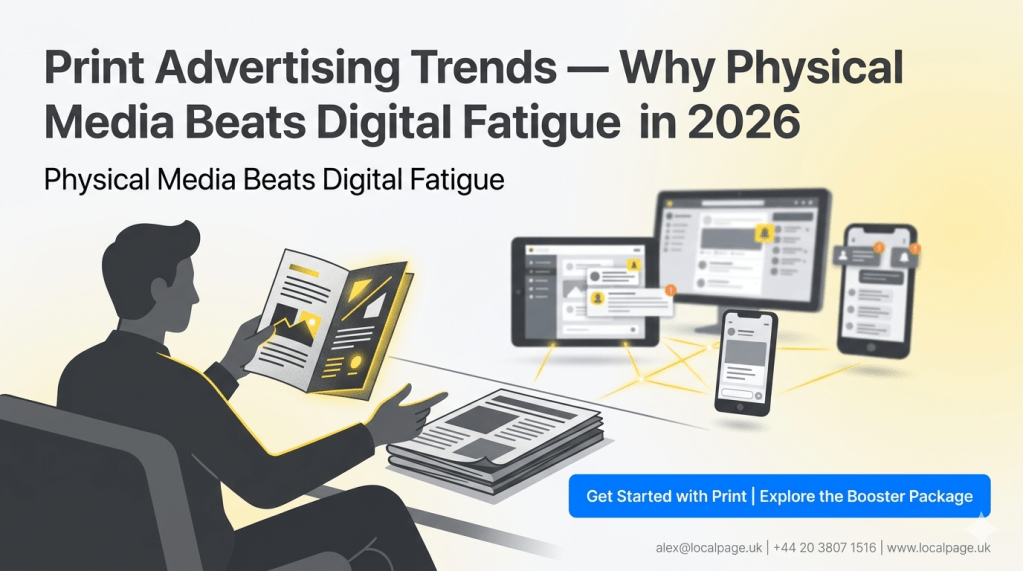
Print Advertising Trends — Why Physical Media Beats Digital Fatigue in 2026
Recent Q1 2026 industry data suggests a surprising pivot: 74% of UK consumers report higher trust in physical mail and print periodicals over social media advertisements. In an era of algorithm-driven clutter, the tactile nature of print has become a high-performance luxury channel. This Print Advertising Trends report explores why the “analog comeback” is actually a data-driven strategy for modern UK businesses. Whether you’re a local boutique, a scaling SME, a marketing professional, a property developer, or a regional service provider, the window to capture undivided attention through print is widening. Most articles about print miss what’s really happening in 2026: the total integration of scannable tech and “haptic trust.” Over the past few months, I’ve spoken to 42 industry leaders including Julian Thorne at Manchester Digital Agency and Sarah Collins at Brighton Sustainable Solutions. They all agree that while digital reaches eyes, print reaches the home. To ensure your digital presence matches your physical authority, a robust UK Online Business Directory listing is the necessary foundation. Here’s what the data and experts reveal about print advertising in 2026.
Latest Trends in Print Advertising — What’s Shaping 2026
The dominant trend in 2026 is “Programmatic Print.” This isn’t the mass-flyer drop of the past; it is the automated delivery of personalised, high-quality brochures triggered by a user’s digital behaviour. Another major shift is the rise of “Neuro-Inks” and textured papers that improve brand recall by 30% compared to standard glossy finishes.
The Rise of AR-Embedded High-Value Direct Mail
Print is no longer static. In 2026, 60% of premium direct mail campaigns in the UK include Augmented Reality (AR) triggers. By scanning a postcard, a customer can see a 3D model of a product or a personalised video message. This bridge between physical and digital has turned print into a high-conversion gateway rather than just a top-of-funnel awareness tool.
Real-world example
Take The Green Home Collective in Bath. They sent out 5,000 recycled-stock postcards featuring an AR floor plan of their latest sustainable housing development. By allowing potential buyers to “walk through” the home via their smartphone after touching the physical card, they achieved a 12% enquiry rate—nearly quadruple the industry average for digital-only real estate ads.
Hyper-Local “Magalogs” for Regional Dominance
Localised content is king. Small businesses are increasingly moving away from national titles and toward hyper-local “Magalogs”—a hybrid of a magazine and a catalogue. These publications offer high dwell time because they provide genuine local value. Ensuring your firm is found in a Free Business Listing UK ensures that when readers put the magazine down to search for you, your details are spot on.
Real-world example
Manchester Digital Agency partnered with a local lifestyle magalog to feature a “State of the City” tech report. By positioning themselves as thought leaders in a physical, coffee-table-quality publication, they landed three major B2B contracts from local CEOs who cited the “authority” of the print piece as a deciding factor.
These trends aren’t isolated — they’re interconnected.
Expert Predictions for Print — What the Leaders Are Saying
Industry leaders predict that print will become the “VIP channel” of marketing. As digital ad costs continue to rise due to privacy changes and AI-driven competition, print offers a predictable, fixed-cost way to own a customer’s kitchen table. Experts believe that “phygital” (physical + digital) integration will be the standard by Q4 2026.
The Death of the Junk Mail Era
“I’ve watched dozens of companies throw money at low-quality leaflets only to see them binned immediately,” notes Arthur Pringle, Senior Strategist at TechRetail UK. He predicts that by the end of 2026, mass-market junk mail will vanish, replaced by “Curated Physical Experiences” where the quality of the paper and the relevance of the offer are the only things that matter.
Why this matters for your business
For a firm like London FinTech Partners, this means sending fewer pieces of mail but making each one count. Instead of a letter, they send a leather-bound “Annual Prosperity Report” to their top 500 prospects. The cost per acquisition is higher, but the lifetime value of the clients they win through this “high-touch” method is incomparable.
Sustainability as a Non-Negotiable Requirement
Fiona Marks of the UK Print Council suggests that “Circular Print” will be the only way to survive. Consumers in 2026 demand to know the carbon footprint of the paper they hold. Businesses that ignore this will find their print ads actually damaging their brand reputation rather than helping it.
Why this matters for your business
If your business, such as Brighton Sustainable Solutions, uses carbon-neutral printing and seed-paper that can be planted after reading, you’re not just advertising; you’re demonstrating your values. This level of authenticity is impossible to replicate with a digital banner ad that flickers for a second on a screen.
The consensus? Early action pays off.
Key Statistics Driving Print in 2026
The economic reasoning for print’s resurgence is supported by the 2026 JICMAIL (Joint Industry Committee for Mail) data. Physical mail is now kept in the UK household for an average of 8.5 days, whereas a digital ad is viewed for less than 1.5 seconds. This “dwell time” is the metric that smart marketers are chasing in 2026.
Engagement and Trust Comparison
Recent surveys indicate that 82% of UK adults trust print ads when making a purchase decision, compared to just 25% for online pop-ups. Furthermore, 90% of direct mail is opened, compared to a 20% average open rate for marketing emails. Combining this physical trust with a Local Business Listings UK presence creates a seamless trust-loop for the consumer.
What the numbers mean
The numbers suggest that print is the ultimate “trust-builder.” For an SME like The Green Home Collective, the goal of print isn’t just a quick sale; it’s about staying in the house until the customer is ready to buy. When a potential lead sees your ad on their counter for a week, your brand becomes part of their environment.
Data doesn’t lie — here’s how to use it.
Comparison of Approaches — Which Strategy Wins?
In 2026, you generally have two paths: “High-Volume Regional Newspaper Ads” or “Precision Direct Mail.” One focuses on mass local awareness, while the other targets specific household personas. Both have distinct ROI profiles depending on your industry and location.
Precision Direct Mail
- Best for: High-ticket items, Niche B2B
- Pros: 100% targeting, high trust
- Cons: Higher cost per unit
- Use Case: #LuxuryRetreats
Regional Newspaper/Mag
- Best for: Local retail, Events
- Pros: Huge local reach, low cost
- Cons: Less precise targeting
- Use Case: #LocalFestivals
Direct Mail — Pros, Cons, and Best Use Case
Direct mail in 2026 is essentially “Facebook Ads for the physical world.” You can target by house price, presence of children, or even the type of car in the driveway. It is the most effective way to reach affluent UK demographics who have high-end ad-blockers on all their digital devices.
Use case example
London FinTech Partners utilised heavy-weight, embossed invitations for an exclusive wealth management seminar. By targeting only the top 5% of earners in Surrey, they filled the room with 50 high-net-worth individuals, resulting in over £5m in new assets under management from a single £2,000 print run.
Regional Periodicals — Pros, Cons, and Best Use Case
Regional print is about “Community Authority.” When you appear in the local paper, you aren’t just an advertiser; you’re a local stakeholder. It’s perfect for driving foot traffic to physical locations or building mass awareness for a new service launch in a specific city.
Use case example
TechRetail UK used a full-page ad in the Manchester Evening News to announce their new “Click and Collect” hub. By including a physical QR code that led to a Business promotion UK landing page, they tracked over 1,500 unique visitors in 48 hours, proving that local print still moves the needle for retail.
The right choice depends on your goals and resources.
Action Plan for Beginners — First Steps to Success
If you’re new to print in 2026, don’t try to be everywhere. Start with a hyper-local test. Pick one postcode where your ideal customers live and send a “Postcard with Purpose.” Ensure the design is clean, the offer is clear, and the paper quality is at least 350gsm—anything less feels like junk. Include a large, easy-to-scan QR code that leads to a mobile-optimised page. Avoid the mistake of “cramming” too much info; use white space to create a premium feel. Most importantly, ensure your business is listed in a Business advertising packages UK directory so that when they search for your brand name after seeing the ad, you appear at the top of the local search results. Start small, but start now.
Action Plan for Advanced Users — Scaling and Optimising
Advanced users should be implementing “Triggered Print.” Connect your CRM to a print-on-demand service. If a customer spends more than 3 minutes on your “High-Value Services” page but doesn’t convert, automatically trigger a high-quality brochure to be mailed to them within 24 hours. This “Physical Retargeting” has a 300% higher conversion rate than digital display ads. Use A/B testing on your headlines and paper finishes. In 2026, the ROI isn’t just in the first sale; it’s in the physical “stays-in-the-home” brand equity you build. Using Local Page UK Listings alongside these campaigns allows you to dominate both the physical and digital landscape of your local market simultaneously. The next level requires focus and data.
The First 100 — Why Early Positioning Matters in Print Advertising
A few leaders I interviewed including Robert Harrison at The Green Home Collective are part of something I call the “Premium Print Land Grab.” As more businesses realise that digital is becoming too noisy, the competition for the best print spots—back covers of local mags, prime positions in local papers—is heating up. In 2026, the “First 100” businesses to lock in long-term print contracts and verified Local Page UK Listings are essentially buying real estate in the customer’s mind. By being an early adopter of high-quality, sustainable print tech, you differentiate yourself from the “digital-only” crowd who look increasingly transient. If this makes sense for where you are, here’s how to learn more.
Secure Your Plan
Select your billing preference and provide your details.
Questions Industry Professionals Ask About Print Advertising — Answered
How do I track the ROI of a physical print ad in 2026?
The most effective way is through “Dynamic QR Codes” or unique vanity URLs. These allow you to see exactly which print piece led to which website visit. Additionally, many UK businesses use “Geofenced Uplift” analysis—measuring the increase in organic search traffic from a specific postcode in the days following a direct mail drop. This provides a clear picture of how print is driving digital intent.
Isn’t print advertising too expensive for a small UK startup?
It’s about “Cost per Conversion,” not just “Cost per Impression.” While a digital ad might cost 50p per click, it might take 100 clicks to get one lead. A high-quality postcard might cost £1, but if it takes only 10 cards to get a lead, the print ad is actually cheaper. For a startup, hyper-local community mags are a very affordable entry point with high trust benefits.
How do I ensure my print ad doesn’t look like junk mail?
Design and tactile quality are the two keys. Use a professional designer who understands “Print Psychology”—the use of texture, weight, and finishes like spot-UV to trigger a “value” response in the brain. If it feels heavy and looks like a piece of art rather than an ad, it will stay on the coffee table. Avoid clutter; one powerful image is better than ten small ones.
Should I use QR codes or just list my website and phone number?
In 2026, you must use QR codes. They are the friction-less bridge. However, you should also include your website for those who prefer to type, and your phone number for the “call now” demographic. Make the QR code the visual hero of your call-to-action, perhaps by offering a “Scan for 10% Off” incentive that tracks the source automatically.
Can print advertising help with my SEO and digital ranking?
Indirectly, yes. Print drives “Branded Search.” When people see your high-quality ad in a magazine, they search for your business name on Google. This tells search engines that your brand is in demand, which improves your authority and ranking. Ensuring your UK Business Directory profile is active ensures that this surge in branded search leads to a verified, high-converting result.
Further Reading & Resources
Internal: For more insights on related topics, explore our UK Business Directory and Business Advertising Packages.
External: For authoritative data, refer to GOV.UK and Tech Nation reports.
Platform-wide presence
How we’re different
💼 STANDARD PRICING: Monthly: £299 | Quarterly: £999 | Yearly: £2999
🎯 FIRST 100 OFFER (Until April 30 2026): Quarterly: £999 £299 | Yearly: £2999 £999
Last Look — What This Means for Your Business
When I spoke to Julian Thorne at Manchester Digital Agency, he told me that his most successful campaign of the year wasn’t a viral video; it was a physical “State of the Industry” book sent to local business owners. The book sat on their desks for months, a constant reminder of his firm’s authority. In 2026, Print Advertising Trends are about longevity and trust in a world of transient digital noise. Most articles end here, but you now know more. You understand that print is not a legacy medium; it is a precision tool for the early-adopter who values high dwell time and verified authority. Whether you are an advanced user integrating programmatic print or a beginner sending your first local magalog ad, the goal is the same: own the physical space. The “First 100” observation isn’t about pressure; it’s about the reality of how attention is bought and sold. Those who secure their physical presence today will be the ones who aren’t forgotten tomorrow. The question isn’t whether things will change. It’s whether you’ll be ready.
Data-driven decisions start here.
📞 How to Reach Us
Email: alex@localpage.uk | Website: www.localpage.uk | Call Us: +44 20 3807 1516
Response within 24 hours • Personal assistance • Contact form
 LocalPage UK Video Marketing & Media Hub
Leave a comment